

Imagine your skin has its own playlist. Sometimes it plays fresh and radiant, other times it sounds tired, tense, and a bit "slowed down". And this is where aesthetic taping enters the scene. One of those beauty hacks that sound a bit strange, but when used correctly can pleasantly complement your home routine. No needles, no scalpel, no dramatic breaks in your calendar.
In recent years, non-invasive skincare has been shifting from classic creams to techniques that also work with muscle tension, puffiness, or mimic habits. Aesthetic face taping is among them. It is not a miraculous overnight erasure of wrinkles, but it can be a clever helper for relieving certain overloaded areas, supporting a feeling of facial lightness, and working more consciously with facial expressions.
What is aesthetic taping and why is everyone talking about it?
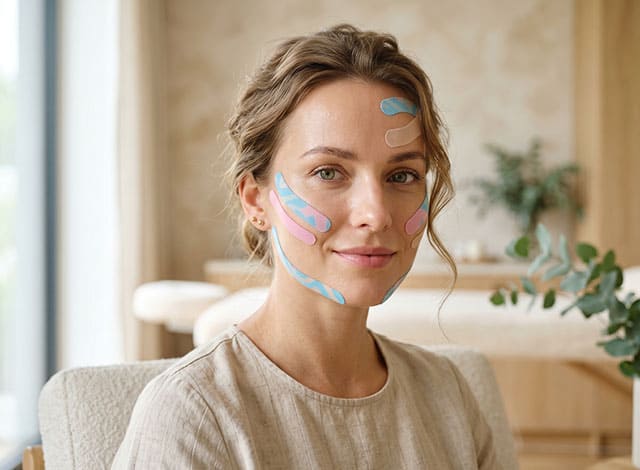
Aesthetic facial taping is based on the principles of kinesiology taping, which is used in physiotherapy. It involves applying elastic tapes to the skin so that they gently lift the skin's surface and affect tissue mechanics. In the beauty world, tapes are mainly used on the face, neck, and decolletage.
Simply put, the tape acts as a very gentle "guide" for the skin and subcutaneous tissues. It doesn't forcefully pull the face upward like a backstage movie facelift; rather, it resembles a discreet choreographer who whispers to tense muscles: "You can relax a little."
How can it work?
The theory of taping rests on several mechanisms:
It is important to state out loud: scientific evidence for aesthetic taping specifically for facial rejuvenation is currently limited. However, there is expert knowledge regarding kinesiology taping in rehabilitation, swelling reduction, and soft tissue work, from which the beauty practice partially draws.
Main benefits: what can you realistically expect?
If you expect real-time Photoshop from facial taping, you will be disappointed. However, if you take it as a gentle addition to your routine, it might pleasantly surprise you.
1. It is a non-invasive method
No injections, no recovery time. For many, this is an attractive gateway to a world of techniques that go beyond just "apply serum and hope".
2. It can help with swelling
Especially in the morning, after poor sleep or during stressful periods, properly applied tape can support the feeling of a "lightened" face.
3. Works with the tension of facial muscles
If you often frown at your laptop or automatically clench your jaw when stressed, tape can act as a subtle reminder that your face doesn't have to carry emotions like an overloaded suitcase all day.
4. It is easy to incorporate into your routine
A short evening application can be managed at home. All it takes is the right technique, patience, and respect for the skin.
How to choose the right tape: not every adhesive tape is a beauty tape
When face taping, the choice of tape is crucial. The face is not a cardboard box and definitely does not deserve an office experiment.
Look for these properties:
Avoid:
Tip: Before the first use, perform a patch test – apply a small piece of tape behind the ear or on the jawline for 24 hours.
Step by step: how to do aesthetic facial taping at home
Below is a safe, beginner-friendly procedure. If you have significant skin issues, a post-operative condition, or lymphatic difficulties, consult the application with a dermatologist or a physiotherapist trained in taping.

Step 1: Prepare your skin
The skin must be: clean, dry, without greasy cream or oil.
If you use rich skincare right before application, the tape may not hold. Imagine trying to stick a paper star onto a freshly buttered croissant.
Step 2: Cut the tape into smaller pieces
Shorter and narrower strips are usually used for the face. Round the corners so they peel off less easily.
Step 3: Apply without excessive tension
For the face, the golden rule is: less is more. Do not pull the tape aggressively. Often, minimal or no tension is enough, especially for lymphatic-oriented applications.
Common areas:
Step 4: Activate the adhesive by rubbing
After applying the tape, gently run your fingers over it. The heat will help activate the adhesive.
Step 5: Leave on for an appropriate amount of time
For beginners, a shorter duration is recommended, for example 1–3 hours, later depending on skin tolerance and expert recommendations, even longer. Not every skin can tolerate overnight wear.
Step 6: Remove slowly and gently
Never rip the tape off quickly. Peel it off slowly, ideally in the direction of hair growth. If necessary, moisten it with water or use a skin-safe adhesive remover.
Warning signs: when to remove the tape immediately
Even the best beauty hacks need to know where to stop. Remove the tape immediately if you notice:
When to avoid taping?
What do science and experts say?
Here is a fair perspective: direct, high-quality clinical studies focusing exclusively on aesthetic facial taping are currently limited. This means that many beauty claims on social media have outpaced the strength of the evidence. Nevertheless, there are expert sources that support some of the mechanisms used in practice:

A small realistic conclusion: tape is not a magic wand, but it can be a clever helper
Aesthetic taping is like a good styling trick in your wardrobe: on its own, it won't solve everything, but it can highlight what is already working. The best results usually come when it is combined with quality sleep, SPF, hydration, gentle massage, and a sensible skincare routine.
If you are tempted by non-invasive skincare, taping can be an interesting experiment – with one condition: approach it with respect, not with the expectation of an instant miracle. Your face is not a battlefield against wrinkles. It is a map of emotions, days, laughter, and focus. And sometimes it really just needs a little less tension.
Want to try it?
Start simple, safely, and observe your skin's reaction. And if you already have experience with taping, share your tips and impressions in the comments. Which beauty hack works best for you – taping, facial massage, or a classic skincare routine?